

Finding Uncle Brian
How and why I came to be

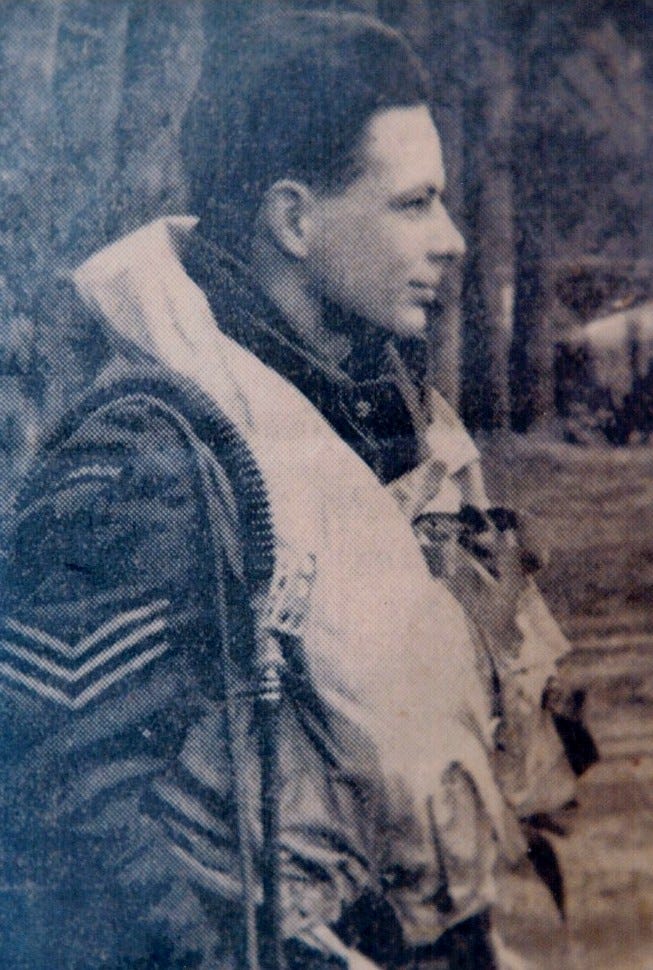
A few years ago, Sylvia invited me to accompany her on a trip to Italy to help her plan and organize a painting tour she was putting together for the fall of that year. I had never been to Italy, so I was glad to be asked. About ten days before we left, my Uncle Eric came to visit his big sister, my then 87-year-old mother. who had recently been hospitalized for a gallbladder operation. Most unfortunately, in the recovery process, she had suffered a very disabling stroke. After the hospital visit, we all went out to my parents' house for dinner with my dad, and while we were there, Sylvia told Uncle Eric about our upcoming trip to Italy. When he heard we would be driving the Amalfi coast, he looked at me and said, “That’s great. Your uncle Brian is buried in Salerno, which is very near there.”
Uncle Eric’s words stirred up conflicting emotions inside me. Besides being seized by a strong urge to go there and do just that, I was overcome by a sense of guilt for not having thought of it myself.
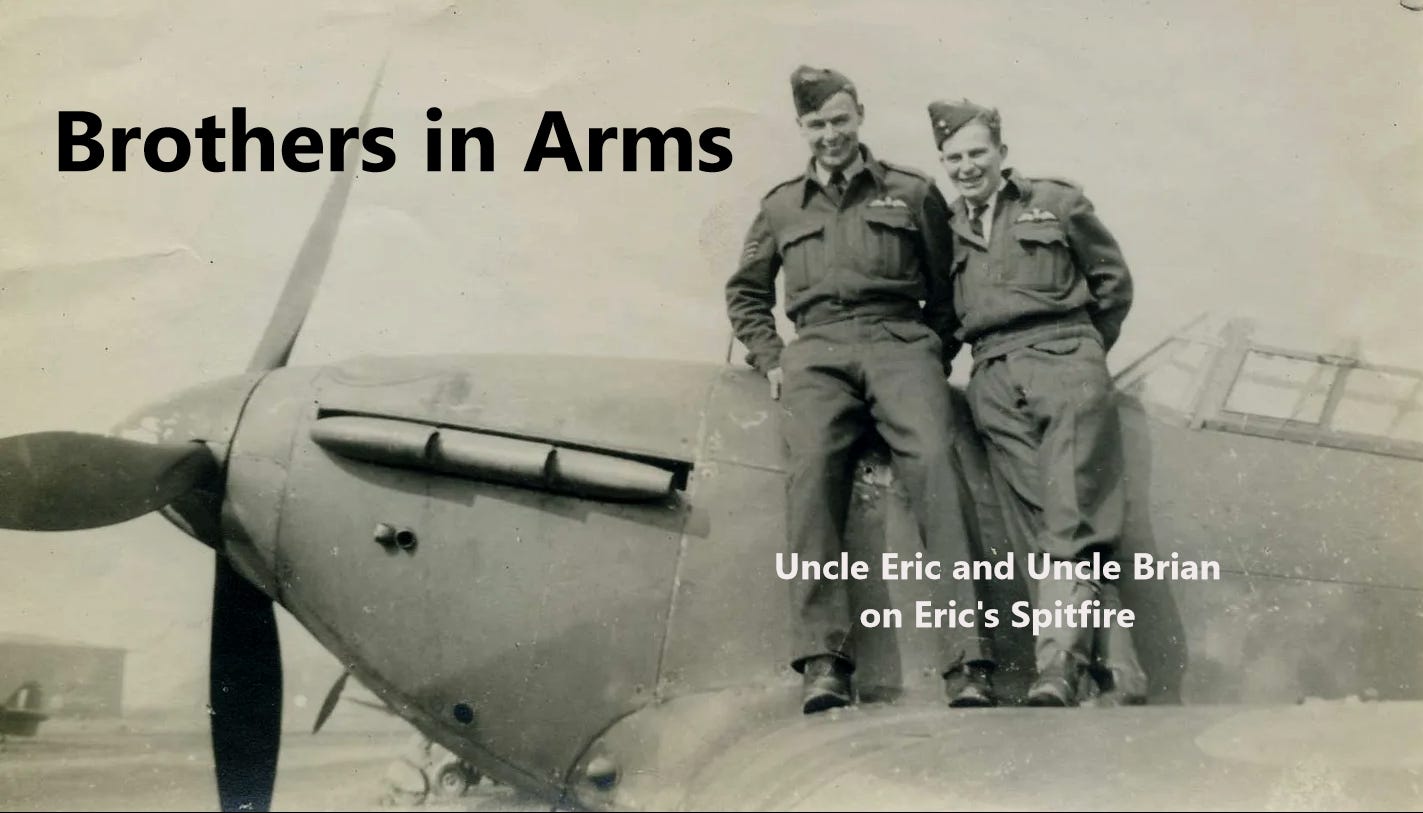
I never knew my Uncle Brian. He was killed just before I was born. He and Uncle Eric, along with a lot of other very young Canadian and American boys, were over in England during WWII, flying Spitfires with the RAF against Nazi Germany’s battle-hardened Luftwaffe. Uncle Eric – who was shot down twice – was one of the last dozen Allied pilots left to defend the island of Malta. According to Winston Churchill, he was one of those few to whom “so much is owed by so many.” While in Malta, Uncle Eric spent some time in the hospital after taking a few rounds from a Messerschmitt that put his Spitfire “in the drink.” His roommate in that hospital was a Luftwaffe pilot named Kurt, and during their recuperation, the two enemies became friends. This, despite the fact that they determined they had both tried on several occasions to shoot each other out of the sky, and would not hesitate to try and do so again should the opportunity present itself.
As they lay in their beds engrossed in a vicious chess game and listening to the daily aerial dogfights going on outside, they would hear a plane going down, and a smiling Kurt would tell my uncle, “Ach… Erikchen, zat sounds like vun of yours.”
Eric would chime back with, “I don’t think so, schnuckiputz.”
Now get this: when Uncle Eric got home from the war, he named his newborn son Kurt – in honour of his hospital bunkmate.
Uncle Brian started off flying Kittyhawks in the battle of El Alamein and the follow-up pursuit of Nazi General Rommel’s forces into Tunisia. Brian was wounded at Gabes in Tunisia while strafing enemy trucks and trains. (“Shot in the leg by an explosive bullet” was how his hometown newspaper - The Wallaceburg News - reported it) As Uncle Eric explained, “Brian’s plane wasn’t really shot down. It was shot up, and Brian was shot up as well.”
After Al Alamein, Winston Churchill famously wrote, "Before Alamein, we never had a victory. After Alamein, we never had a defeat.”
Brian was not too thrilled about flying Kittyhawks because his younger brother Eric was flying Spitfires, which were much better-performing fighter planes when up against the Luftwaffe’s formidable Messerschmitt BF109Es and the Focke-Wulf FW190s. As luck would have it, after his recovery, Brian was posted to the 93rd RAF squadron in time for the invasion of Italy, and that’s where he got to fly a Spitfire.
By 1943, the Italian citizens realized that the whole Hitler/Mussolini world domination thing was just not going to work out, so they literally hung Il Duce out to dry and joined the Allies in an effort to atone for their sins by helping rid the world of Hitler and ending this horrible war. At the same time, my father was “somewhere” in the North Atlantic doing escort duty for the Royal Canadian Navy, which entailed trying to find the dreaded Nazi U-Boats before they found and destroyed the ships - along with their precious supplies - that my father and his pals were trying to protect. He’d had one shore leave, and as a result, my pregnant mother was expecting me to arrive in mid-October of 1943.
The joke in our family was that when I was asked if I’d ever been to Newfoundland, I would say, “Yes. I went with my dad and came home with my mother.”
If she had a boy, she was going to name him John Eric Keelan. My father, jokingly (I think), claimed he had suggested naming me Shore Leave Number One after one of his favourite weekends of World War II. My brother Eric, who came along eleven months later, was duly referred to as Shore Leave Number Two.
On September 24, 1943, the war-is-hell thing stepped in, and Brian Crist was reported missing “somewhere” over Italy. It turned out his Spitfire had been shot down north of Salerno, Italy, in the Lepini Mountain range, where he had been flying cover for our boys on the beach below during the Allied landing at Salerno.
Nineteen days later, he was still missing in action, and I was born. I was named Brian Anthony Keelan. Brian, for obvious reasons, and Anthony, since St. Anthony was – at that time in the Roman Catholic world - the patron saint of things lost, and my mother and the rest of our family were desperately praying for the safe recovery and return of my now Uncle Brian.
Sadly, the answer to their prayers was “No.”
Brian’s remains were found ten days after he went down, but his death was not confirmed to my grandmother until December 1943 – six weeks after I was born.
Here is how my uncle Eric described it to me:
“Brian was flying a Spitfire VB with the 93rd RAF Squadron when he was shot down. His squadron was covering the troop landings at Salerno, Italy, where the Allies were attempting to establish a beachhead. The 93rd Squadron’s mission was to protect the Allied troops from being strafed by the Luftwaffe while they were on the beach, where they would be extremely vulnerable. Brian and his squadron were probably trying to intercept the enemy fighters before they even reached the beachhead. We know this because the engagement took place at about 15,000 feet. One or more squadrons of German FW 190s were intercepted, and in the ensuing dogfight, several planes were shot down, including Brian’s. I believe he managed to bail out as there was no report of any wreckage at the point where he was found, somewhere near the top of Mount Avelino.”
At age seven, I remember my grandmother showing me a picture of Uncle Brian in his uniform, sitting up on the hood of his big Spitfire fighter plane – grinning from ear to ear. That’s the actual photo you see below, and it, along with a picture of his gravesite, stayed in my grandmother’s purse until she passed away in 1982, when it was transferred to my mother’s bible. Since I was named after Uncle Brian, I’ve always felt some kind of emotional connection to him. I knew that his death broke my grandmother’s heart. I remember seeing her cry when she showed me the picture and told me about it. It was the first time I ever saw an adult cry. I remember being surprised that adults cried just like I did, and I realized it was a lot more serious than the things I cried about.
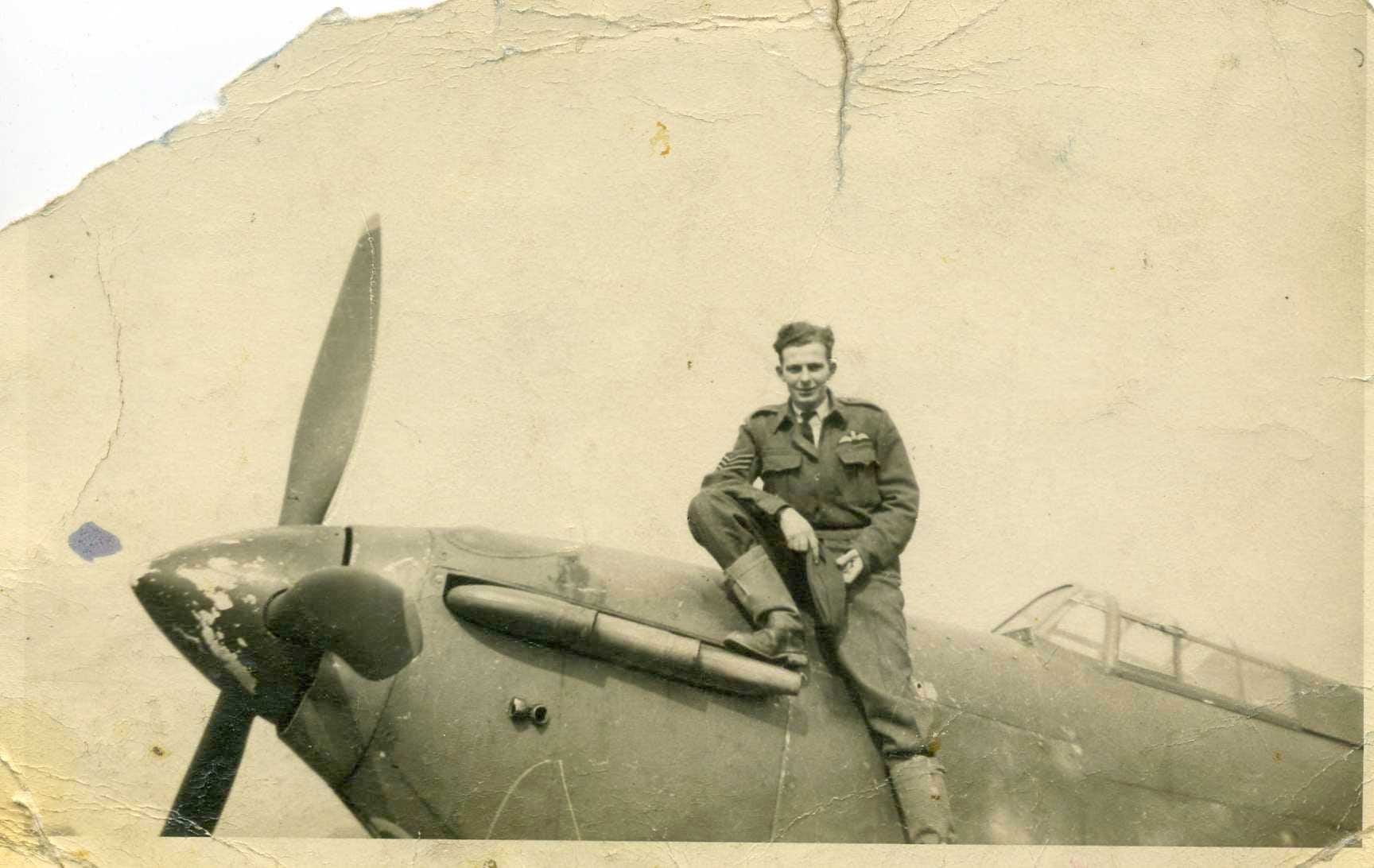
Uncle Brian “somewhere” in Europe
And so it was that after a wonderful week in Rome and then Spoleto, Sylvia and I drove south to Salerno – an ancient city with world-famous beaches facing the Mediterranean Sea at the foot of coastal mountains. The beach area is a large delta formed at the mouths of a couple of rivers flowing down from the coastal mountains, and it provided the Allies with the only natural place to land their troops and gear, since Italy is a wall of solid rock along that coast.
The Allied landing at Salerno was called Operation Avalanche. It took place on Sept 9, 1943 – the day after Italy withdrew from its Axis alliance with Germany and Japan. Between the 12th and 14th of September, a lot of vicious fighting took place there. After landing on the beach, the Allies’ first task was, according to John Blunt, a longtime friend of my dad’s, “to get off that goddamned beach!” Blunt – who grew up in Port Huron, Michigan – was a beach commander for the U.S. Marines at Salerno. The tactical problem they faced was that the beach was at the foot of all those coastal mountains, and the roads up top were manned by hordes of German soldiers with plenty of artillery, as well as the Luftwaffe providing air support.
A few days later – after 2,149 Allied soldiers and 840 German soldiers were dead – the Allies had moved up off that beach and now owned the roads up top. I was stunned by the fact that we had lost almost three times as many men as the Germans. It wasn’t really a victory; it was more like a “mission accomplished” thing.
Uncle Eric told me, “It was touch and go there for a while, and we paid a hell of a price for that beach.”
I said, “It looks to me like once the Germans could see where all this was going, they figured they had to conserve their resources because the Italians were no longer willing to die for their cause and figured, ‘Hey, we’re way ahead on the body count, but we’re losing ground. Let’s get the hell out of here!’”
With a shrug of his shoulders and a somewhat disheartened smile, Eric said, “Something like that. Whenever that many young men die trying to solve old men’s problems, the people who didn’t do the fighting yet make the decisions as to whether or not there will be fighting, don’t want anybody to know what really happened and, most especially, why. So, the truth gets lost somewhere in the mists of time.”
Like old Aeschylus said, “In war, truth is the first casualty.”
When Sylvia and I got to Salerno, our first job was to find the cemetery, a process that involved Sylvia asking friendly yet puzzled citizens, “Dove e cimmiteria Anglasia?” Once they (sort of) understood what she was asking them, they would smile and do a few minutes in rapid-fire, totally unintelligible (to us) Italian. Except for the occasional name of a town, we understood nothing. But they always pointed – inland and to the south. By repeating her efforts another six or seven times, we gradually worked our way to The Salerno War Cemetery, a large, very green, and very beautiful field surrounded by a low stone wall.
Carved into the granite base of the gate was the sentiment: “The land on which this cemetery stands is a gift of the Italian people for the perpetual resting place of the sailors, soldiers, and airmen who are honoured here.”
As I read that, I cannot begin to describe the feelings that swept over me – a very real and unexpected emotional sensation.
But why? I’d never been here before. True… I did have family here. Not Italian family. Canadian family. A member of my family - whom I had never met - had come over here to fight in a war and had been killed in action and buried here. He was a war hero in a war that, for me, existed only in books and movies. I thought of my grandmother one long ago, Remembrance Day, sitting on her bed and crying as she looked at her picture of Uncle Brian. Standing here - now a parent myself - I understood some of her pain and tried to imagine the rest.
I could not. Instead, I felt guilty for living and never having had to even go to war. My dad, his brother, and two of my mother’s brothers had all done it, so I wouldn’t have to. They had come home believing that the world “had had it with war. Never again.”
Yeah… right.
At the gate, there was an alphabetical list of all the people who were buried there. Inside the gate were rows and rows of neatly manicured graves – each with its own marble headstone. One thousand eight hundred and fifty-one of them. My hands were shaking as I scanned the register until I finally found his name:
CRIST, Wt, Offr. II. (Pilot) BRIAN VINCENT,
R/93427. R.C.A.F. 93 (R.A.F.) Sqdn. 24th September, 1943 Age 24.
Son of Alfred and Sophia Crist, of Wallaceburg, Ontario, Canada. III.D.33.
There was a guest register there to sign, and I opened it. A lot of people come here. We were the seventh register of this day; five from England and two from Canada. They listed themselves as sons, brothers, relatives, and friends – there was even one visitor who had actually fought here.
I turned to Sylvia, took her hand, and with tears in our eyes, we headed out onto the field to look for his grave. Sylvia’s father had flown over here – for the R.A.F. – in the same war. He, too, had been shot down and barely survived. He’d been headquartered in England, and we wondered aloud if they’d ever met.
The cemetery is divided into two halves, so we split up to begin walking the rows and rows of graves, searching for Uncle Brian. I took the right side and, starting in the first row, began reading the inscriptions. I thought about my own son and my twin daughters. Everybody who is buried in that first row was younger than my children today when they died. All these people were old when I was born, and now they are younger than my own children. My god!
It was in the third row – a marble headstone about four feet high. The plot was very well tended, and flowers were growing around it. On the headstone were the words –
R. 93427 WARRANT OFFICER II
B.V. CRIST
PILOT
ROYAL CANADIAN AIR FORCE
24th SEPTEMBER 1943 AGE 24
I felt a chill as I recalled seeing that exact description years ago in a photo my mother had kept in her bible ever since she and my father visited his grave in 1961. I thought again of my grandmother sitting alone in her dining room, sobbing as she looked at her picture.
On the bottom of the headstone were the words…
OUR SON WENT
“THROUGH ADVERSITY TO THE STARS”
GOD GRANT HIM REST AND PEACE
I could not stop the tears as I read the words and tried to imagine how my grandparents must have felt when they were told there was room on the bottom of the headstone for a personal sentiment and asked if they would care to provide it. I asked myself, “What would I say if this were my son?”
I called out to Sylvia. She walked over to stand beside me, and we stood there silently, taking it all in. This beautiful place on this beautiful day, where people come from all over the world to experience what we were experiencing right then and there. All of us would walk away from here, forever changed by this experience. We would all try to imagine what had happened here back then, and we would never forget how we felt on this day.
World War II was a very complex series of events and cannot be explained in one or two lines, but basically (I think), war essentially comes down to good guys trying to stop bad guys from doing bad things to good people who just basically want to build a decent life and be a part of a fair and just system. That doesn’t seem like a whole lot to ask for, but it’s a hell of a lot to die for, and many fine young men have paid, and – if history is any indication – they will continue to pay that dreadful price. Sadly, it seems the only thing we have learned from all this is that we have learned nothing.
History will show WWII to be the last war ever fought like this: young men (and now it seems, women) challenging each other head-on with planes, boats, guns, bayonets, and all kinds of other very expensive things that go boom. I pictured Uncle Brian at the age of 24, flying this big 12-cylinder, 1230 Hp, single-seat, hot rod airplane loaded with four 303 Browning machine guns and two 20 mm cannons, going up against all the bad guys who were just young men like himself doing the same thing for what they believed was the same reason. Speed, the element of surprise, skill with a joystick, keen eyesight, a sense of fearlessness, and some plain old-fashioned luck were what counted up there.
And for what? Was it so that I would be able to come back here many years later and learn what had happened here in a way I could never learn from a book or a movie? The big lesson? Life is very precious. It costs a lot.
The obvious questions are:
1: Is the price they paid worth it?
2: Why the hell are we still doing it?
An unforgettable hour later, as we turned to leave, I plucked two flowers from the small, well-tended batch that grew around Uncle Brian’s headstone and put them in a book – a yellow one for my mother and a purple one for Uncle Eric. We also took some pictures. I almost felt at home here now because Uncle Brian was here. My family was here. My name. I wondered if there was any way he could know that. If so, how would he feel? What would he tell me?
We were silent in the car on the way back to Sorrento, both of us thinking about our relatives and friends of our parents who had fought here, been hurt here, had died here. Angry at the Hitlers, Mussolinis, Stalins, Amins, Pol Pots, bin Ladens, Maos, Putins, and all the rest of history’s monstrous, bullying assholes who feel/felt it was their destiny to impose their appallingly brutal, selfish, twisted delusions on innocent people. What’s even more disgusting is that they were afraid to do it themselves, so they got the kids to do it.
We spent the next three days in Sorrento. But the feelings I experienced at the cemetery never left me. On the second day, they were dramatically brought back to me by a group of veteran New Zealand soldiers (Anzacs) staying at our hotel. They had come here to be part of the 60th anniversary of the Battle of Monte Cassino. The Allies had fought a brutal and costly battle there after they got up from the beaches at Salerno. It lasted from December 1943 until May 1944. It took 240,000 Allied troops four months and one day to remove and defeat 140,000 very well-dug-in German soldiers. We lost 55,000 men in that battle and killed 20,000 Germans in the process. I imagined an Allied general telling the press about the great “victory” that had been won here - we lost 34% of our troops while the Germans only lost 14% of their troops because they finally said, “Screw this!” and left. I thought of my Uncle Eric and his comment about truth, victors, and the mists of time. And I did not feel the thrill of victory. I’m sure my mother and my grandmother and a lot of other wives and mothers were just glad that it was over and the killing had stopped… but just for a little while.
The leader of the Anzac veterans, a man they called Jimmy, had been badly hurt in that battle; a grenade, I was later told. Half of his face had been mutilated, and as a result, he had an artificial nose. He was unable to travel with his unit that day because, in their travels, he had acquired an infection in his still-open facial wound and would have to remain at the hotel while the rest of his regiment went to the victory remembrance at Monte Cassino.
As I sat on the steps of the hotel and watched these men, all in their late seventies and eighties, board the bus that would take them to Monte Cassino, I could tell that, to a man, they felt terrible that Jimmy would not be with them today. Holding a white handkerchief over his face to cover his infection, Jimmy stood at the bus door, shaking their hands and hugging each of them as they boarded. Then he stood there alone, waving goodbye as the bus pulled away. When they were gone, I watched him turn away and walk, alone, back toward the hotel. He was crying.
So was I.
I looked up at him as he passed me, and we lamely smiled at each other. I saw his tears, and he saw mine. He gently patted me on the shoulder and kept on walking. There was nothing I could say. There was a whole lot I wanted to say, but I had not been there. I had not earned the right to tell him I could feel his pain. I could only try to imagine it. He was younger than my kids when he and his gang had fought here, and now, as old men, they felt compelled to return and honour their comrades who had fallen here. I hoped that whatever had happened at Salerno and then Monte Cassino was well worth the price these brave, wonderful men had paid for it.
As he slowly climbed the steps to our hotel, I stood up and, still crying, I said, “Hey… Jimmy… Thanks.” He didn’t turn around. He just raised his free hand, nodded his head, and kept walking. As long as I live, I will never forget that man and that moment.
When I got back home, I showed my mother the pictures I had taken and gave her the flower as a souvenir. She was so glad that we’d gone there, and we both shed a few tears as I told her how it had affected me. When I wrote to Uncle Eric and told him, he, too, was very glad to hear that we had gone. I think it was good for both of them to know that Uncle Brian’s life and death still mean so much to those of us who came after him.
After my mother passed away, I found the diary my grandmother kept during that terrible time. These are her entries:
· Sept 24/43: “Telegram saying he is missing at Avellino, Italy. (Please God!!!)”
· Dec. 1st/43: “Telegram says he is dead and buried by Italians on top of Mt. Lepini two miles north-east of Salerno, Italy. My darling Brian! My heart is broken! I can’t believe it that I will never see him again.”
I think I’ll go and give my kids and their kids a great big hug. Because of the sacrifices of men like my Uncle Brian, Uncle Eric, Jimmy, and his ANZAC buddies, and millions more just like them, I can do that whenever I want… so can you.
As Sylvia likes to tell me, “Aren’t we lucky?”
So then, peace to you, my brothers and sisters, and as Christopher Columbus told his crew on his way across the ocean, “Watch out for the edge!”
****
Thanks for reading my Close to the Edge story. Please click the Subscribe button to receive new posts and help support my work.
WOW. Very impressive Mr. Keelan. Of course, I wasn't surprised at all - that's who you are & underneath that gentle exterior, a great writer. Thnx for sharing!!